3 decor styles I’m obsessed with

I can spend hours online looking at home decor.

I can get lost in subway tile, glitzy chandeliers and area rugs with geometric patterns.

I love to watch other decor lovers create beautiful spaces in their homes. It’s a great place to gather ideas, inspiration and lessons learned.

I especially love when they take me on a virtual tour of Target or Home Goods and show me new arrivals.

A lot of it is beautiful. But if I had to choose three styles that make me drool, I would narrow it down to these:

Grid accent wall

I absolutely love the grid accent wall. It’s the perfect embellishment that goes way beyond just painting the wall a different color.

If I had my druthers, I would install this feature in the stairwell.

As much as I love my house, the stairwell leaves a lot to be desired. It’s tucked between the dining area and bathroom just off the living room.

There are two flights of stairs and the second flight is a virtual tunnel that leads up to the loft.

The grid accent wall (also known as a board and batten grid accent wall) is a series of intersecting boards that create a box or grid and adds visual interest to an otherwise boring space.

What I love most about this feature is how unexpected it is. You rarely see a whole room done up with the grid accent wall. It’s usually used on only one wall, nook or cranny.

The stairwell has its own dedicated space. It has an opening and an end point. It serves the bottom floor and the top floor without being a part of either story. The stairwell is suited for – and deserving of – a beautiful feature like the grid accent wall.

Gold fixtures

I’m loving all things gold these days. And not gaudy gold decor that looks cheap and trashy. But tasteful gold that adds just the right amount of elegance to a room.

For example, have you seen green or blue cabinetry with gold hardware? If you haven’t, you must search out these color combinations. You’re probably thinking, “Blue cabinets? Or better yet, green cabinets?” But trust me, it works.

Blue cabinets with gold pulls, marble countertops and white subway tile is my dream kitchen. I realize green and blue cabinetry will likely fall out of style as quickly as it came in. But if money were no object and if time stood still…

Gold also has made a comeback in light fixtures, sometimes as the dominant color and sometimes as the accent color. But it’s all breathtaking, adding pops of glitz and glam in your color palette.

And that’s what’s great about gold. A little goes a long way. You wouldn’t want to overdue the space in gold – that’s where the gaudy comes in – but a gold chandelier here and gold cabinet pulls there add the sparkle you didn’t know your space was missing.

Faux plants

I joke that I’m fast becoming the crazy plant lady, but there’s also some truth to it. It seems I cannot place a Target order without throwing in a faux eucalyptus plant or succulent.

No worries. I’ve been keeping it in the ten- to fifteen-dollar range.

But the time will come when I finally splurge on that two-hundred-dollar faux fiddle-leaf fig tree I’ve been eyeing at World Market. And not just one tree, but three trees – one for the dining area, one for the bar room and one for the loft. Now you know why I’ve been holding off.

I’ve never been a fan of fake anything, but fake plants have come a long way since the 1990s. And the small plants I’ve been ordering from Target are easy to place here and there without cluttering my home.

They help bring the outside in, which is important in the summertime when it’s too hot to venture outside. They add spashes of green in a sea of neutral earth tones. And they add life – even fake life – in a world of inanimate objects.

Plus they’re absolutely adorable. But don’t take my word for it. Check out the photo below of my mini faux fiddle-leaf fig plant.
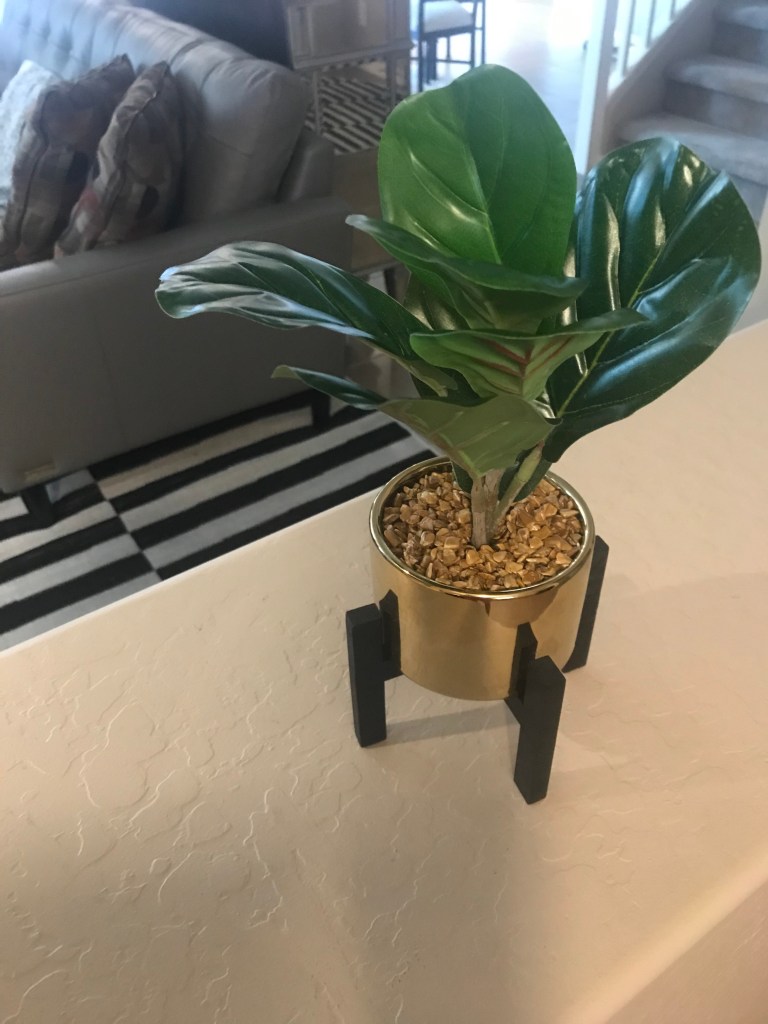

It’s no wonder I’m in love with faux plants. This fiddle-leaf fig is adorable. Photo by Cindy Hernandez.

Too early for fall decor

There are two camps today in the decor world:

Those who think it’s too early to decorate for fall and those who think it’s never too early to decorate for fall.

I fall into the former camp.

It’s August. It’s Arizona. We’re still dealing with 100-plus-degree temperatures outside. No amount of plastic pumpkins is going to cool the weather or make autumn come faster. No amount of maple leaves strewn across the walk are going to psyche me into thinking it’s 60 degrees out.

Besides, I don’t hate summer. In fact, I’ve come to enjoy it.

Summer loving

Summer is Phoenix’s slow time. The off season. It’s the time of year that fewer people are in town (though I wouldn’t know from experience anymore since I rarely leave the house).

Summer is the quieter season. Hardly anyone is outside. Neighbors walk their dogs or venture outdoors for exercise in the early morning hours or later at night, and the walks are pretty quick. It’s a virtual ghost town compared to winter months.

Summer is hibernation time, which works for my hermit tendencies. There’s nothing more comforting on a blazing-hot day than air-conditioning, the sound of cicadas and an afternoon nap.

But here’s the real truth.

Enjoy today

Pumpkins lead to turkeys, which lead to snowmen and Christmas trees. Then, we’re at the eve of the New Year.

I’m in no rush to see 2020 end. Not because it’s been a fabulous year, but because it hasn’t been a fabulous year. Sound crazy? Let me break it down for you.

The years move fast enough as it is, and 2020 has moved faster than any of my 48 years. Time is slipping through my hands, and I still have a lot goals I want to accomplish.

On a larger scale, I want to hold onto the year so that something good can come of it. Even though the chances of that are slim, I can still hope. If this still doesn’t make sense, let me flip it around for you.

What will 2021 bring? Maybe a vaccine. Maybe social change. Maybe peace on our streets. The new year could bring all of those things, or one or two of those things. Or it could bring none of those things.

What if 2021 is more of the same, or worse? So why wish away the time we do have? Why wish away our lives for something that isn’t guaranteed?

Besides, I’m not 100 percent certain that nothing good has happened in 2020.

Small joys

Take this blog, for instance. This blog had been in the works since 2018 when John and I decided to buy a new house together. I had big plans for decorating each room and sharing the journey on a design blog.

After some procrastination, I finally put my butt in gear, bought a laptop and got to writing. Because I have a full-time job, I knew I would have to devote evenings and weekends to the blog.

But not even two weeks after launching Designing Goldilocks, my employer told me to work from home until further notice because of the coronavirus. That meant I could turn the two hours per day I spent commuting into working on content for this blog. What a gift.

That’s not to say I’m thankful for the virus. Nothing could be further from the truth. Does 2020 suck? Yes, it does. But I also believe we can find small joys in 202o if we simply stop and look around.

Discoveries

And that’s exactly it. No one stops anymore. Everyone is on the go. Chasing the next thing rather than enjoying what they have. And I’m guilty of this myself, which is why I can speak to it.

If nothing else comes out of 2020, I would hope that I at least realized what’s important in life. Even though I write a design blog, I’m taking a more minimalist approach to home decor.

I’m buying what’s essential – rugs, curtains, furniture – and saying no to tabletop items, which is really all that fall decor is.

Don’t get me wrong. It’s fun to shop for this stuff and decorate the house and lawn. One of my guilty pleasures is watching others venture into stores and sharing on social media new finds from Target, HomeGoods, and other decor stores. But it’s no fun taking down the stuff and finding a place to store it.

Stuff is not important. It’s who you have in your life that’s important. The coronavirus hasn’t kept me from my stuff. The virus has kept me from family, friends, and the freedom to explore the world and the gems within my beautiful state.

Rather than rush to set up hay bales on my front porch, I long to travel to real pumpkin patches and sunflower fields. Rather than create a fall facade across the lawn, I long to drive to the mountains and see real leaves changing colors.

But I can’t have that. At least not right now. Maybe I can spend time with family and travel a year from now. But there’s no guarantee. So why rush the time away? I know what I have today. And I’m okay with today – the joys, the warts and all.

As fall approaches, I long to visit pumpkin patches and sunflower fields. Photo by Cindy Hernandez

5 home-decor comebacks

The 90s are back. And the 80s. And maybe even the 70s.

Just like with clothes, the styles of home decor come and go. And 2020 is no exception to styles of years past.

And while these styles are throwbacks to various timeframes, the styles work well together or on their own.

Here are 5 home-decor styles that have made a comeback:

Rubber plants

Big-leaf trees whether real or fake are all the rage. And no matter your interior design, the rubber tree is the perfect decor piece to pump life into a room of inanimate objects.

And because they are vertical and dwell in the corners of the room, they take up hardly any space at all. And it’s hard to stop at just one tree. In fact, it’s hard to stop at just trees.

Faux plants are perfect for tabletops and shelves. They’re a great way to bring the outside in, and work well in apartments or homes with little to no outdoor space.

If you’re into hanging plants, the fern is the way to go, giving its spider-like stems a place to grow. They do well in just a pot. But if you really want a blast from the past, hang the fern from a macrame potsling.

Macrame

The popular textile made from linen, yarn and various other materials is a surprising comeback, and surprisingly works well in any decor.

The two most popular uses are wall art and pot hangers, and typically complement the simpler crafty do-it-yourself decor. But macrame also complements shabby chic and farmhouse styles.

Because the most common colors of the material are white and beige, the macrame blends into the space, instead showcasing the pattern of the wall art or, if a potsling, the plant it holds.

Southwest flavor

Area rugs are a home-decor staple these days. You can have tile, hardwood or carpet flooring, but the room will appear incomplete without an area rug.

And the rugs run the gamut in colors, patterns, textures and styles. It’s rather overwhelming to try to pick one. Stripes or solid colors are safe choices. But what blew me away when shopping for a rug recently was how many rugs have a Southwestern pattern.

You don’t have to live in Santa Fe or have an adobe home in the Southwest to grace your floors with one of these rugs. The Aztec pattern works especially well in the modern farmhouse, the minimalist industrial loft, and the high-end masculine penthouse.

Gold and brass

Just when everyone changed their fixtures and finishes to silver, here comes brass and gold again. That’s the thing about home decor. You can’t keep up.

Most of us cannot afford to decorate our entire house in one fell swoop. We take on one or two rooms at a time. And once we’re done with the last room in the house, if we even get that far, the first room is practically outdated.

The same goes for metals. From candle holders to light fixtures to pulls and knobs, gold and brass are adding sparkle where silver and nickel had removed it.

But there’s some good news: It’s okay to mix metals. This means you can have gold cabinet pulls and stainless steel appliances in the same kitchen. (See my blog post “Putting metals to the mettle,” March 23.)

If you’re in a position to have a cohesive metal, more power to you. But if you like the mix of gold and silver, it’s perfectly acceptable. In fact, the mix of metals in one room comes across as intentional.

Egg chair

Yes, you read that correctly. The egg chair is back.

If you want to make a statement with your furniture, consider the egg chair. Even though it has a very Copenhagen style and often found hanging on the front porch, they also work in a girl’s bedroom or in a feminine living room.

They are versatile in that they hang or come stationary. The chair frames vary from wood to black and complement any color palette with the throw pillows and blankets you choose to embellish them with.

I had resisted this comeback. During a trip to Sedona in 2018, the hotel had a hanging egg chair on the patio. While it seemed fun for a hotel, it wasn’t something I wanted to replicate at home.

But would you believe that the style has grown on me? Now I have my eye on a stationary $500 egg chair – yes I said $500 – that I haven’t been able to justify. But in my decor dreams, I see the egg chair as the focal point of a reading nook in my work-from-home space.

Too bad the price tag from years past didn’t return with this home-decor comeback.

The egg chair as seen on the patio of this Sedona hotel has made a comeback. Photo by Cindy Hernandez

5 steps to pantry organization

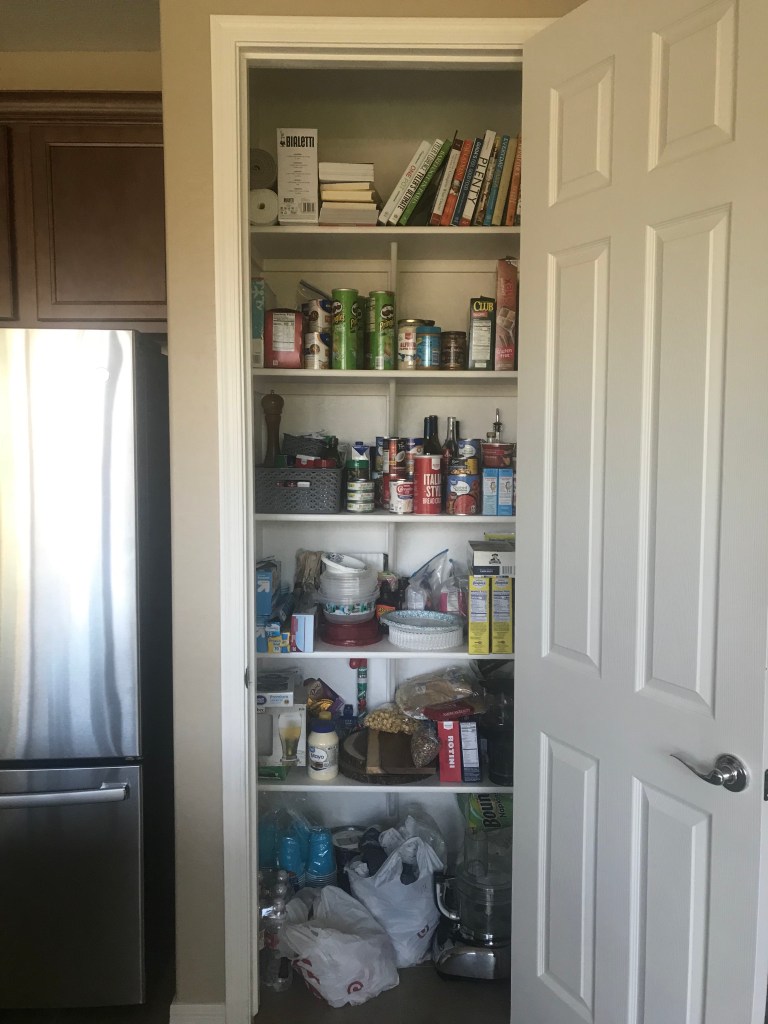
So I finally organized my pantry. Yes, after one year in the new house, I finally completed the project I thought would be done by now.

I had originally planned to line the shelves the first weekend in the house. I had liners in two colors so that I could have options.

I thought I was being smart, you know. Thinking ahead. I would line the shelves while the pantry was still empty before that first big trip to the grocery store.

Wrong.

The pantry fell by the wayside. With all of the busyness of moving into a new house, lining the shelves got pushed down the priority list. Way down.

But it always bothered me. Every time I opened the pantry door, I would see a project that wouldn’t have taken much time at all.

The pantry is small. Like linen-closet-size small. There was no excuse not to get it done. And it wasn’t that the pantry was messy. The items were already neatly arranged in zones that made sense: soups, spices, cereal boxes, cookbooks.

I could have easily left it that way. And I did for one year. But rather than seeing labels when I opened the pantry door, I wanted to see one cohesive color or pattern across all of the shelves.

So one day I cleared the calendar, threw away the excuses and got to work. It took me a couple of hours, start to finish to organize the pantry. And that included stopping for a quick lunch.

I’m happy with the results, and even more happy to share with you 5 steps to a tidier pantry:

Discipline

Before tackling the pantry, or any space in the house, ask yourself why you want to organize it. The obvious reason may be because you want the space to look nice when you open the door. That’s a given. But organization also takes discipline. What I mean is, you have to consciously put items back in their place. You can have all of the storage bins in the world, but they’ll do you no good if the celery salt gets lost between the large cans of crushed tomatoes.

Appearance

Picture an organized pantry. What do you see? Is it solid or clear containers? Do the containers have labels or no labels? Do you want spices on turntables? Do you want to keep cereals and pastas in their original packages or transfer them into containers? The options are seemingly endless. And quite overwhelming. But choosing the containers also is the fun part. And it’s almost easier to find the bins you like first and then decide to organize the space. And that’s often how organization starts. You see an awesome system at the store and then get the brilliant idea to organize your house just so you can buy the pretty bins. But again, do you have the discipline to keep it organized?

Other considerations

It’s not necessary, but lining the shelves may add an extra touch to the space. I chose a brown non-adhesive liner that is both durable and washable. I chose to line the shelves because sometimes I like to take the bins out of the pantry and place them on the counter as I’m prepping to cook. The liner protects the shelves from being scuffed up in the process. If I truly had been thinking ahead, I would have painted the interior of the pantry to match the kitchen walls. There’s always next week.

Organizing

Now comes the hardest part, and yet I found this part to be quite therapeutic. Because my pantry was already organized in zones, all I had to do was remove the items shelf-by-shelf and then place them back on the shelf in their dedicated bins. This was also a great time to throw away items that had expired. When I placed the items in their bins, I organized them by date. What I mean is, for the bins that have 3 jars of spaghetti sauce, I put the newer jars in the back and the older one in the front so that I was sure to use that one first. I also placed the items I use frequently at eye-level (spices, peanut butter, oils and vinegars), the items I rarely use on the top shelf (cookbooks), and the bulky items at the bottom (bottled water and paper products).

Enjoy

I’m happy to have an organized pantry and I think you’ll be too should you undertake this project in your own home. It’s nice to open the door and see one cohesive look. If there is a drawback, it’s that the bins themselves take up real estate that reduces space for pantry items. But it’s not enough of a drawback to go back to the way it was before. In fact, I’m already eyeing John’s pantry in the loft. Now THAT would be a lot of fun.

Storage bins can transform your pantry, giving each item a dedicated space and the pantry one cohesive look. Photos by Cindy Hernandez

DIY: A window valance

If you were to fast-forward 1o years into the future and research homes that were decorated solely from online purchases during the pandemic, you would see my house.

When I say I only shop online, I truly mean I only shop online.

I don’t remember the last time I stepped foot inside a store. It may have been Target earlier this year. And it was only because I needed a humidifier.

Before that, it was probably an At Home store last fall for bathroom accessories. And Macy’s in December, but that was for Christmas shopping.

I was slowly decorating the home and buying pieces as I gave myself permission to.

But when you’re in a pandemic and strongly encouraged to stay home, what do you do? You put the decorating plan into high gear.

And when you shop only online, you have to hope your vision for the space plays out well in real life.

I have been fortunate when shopping online at Target because I already know what the decor items look like. Besides, a faux plant is a faux plant is a faux plant. How wrong could it be?

But there are only so many fake ferns that one can buy before you have to face the fact that if you don’t want your style to grow weeds, you’re going to have to trust your judgment and take some chances.

Enter window treatments.

The house came with blinds as a standard feature, and they are perfectly fine on their own. But I always envisioned adding curtain panels to spruce up the window and add a touch of elegance to the rooms.

But a professional job would have meant booking an appointment for someone to come into the house to take measurements and install.

And as you may recall from my last blog post, I am not allowing strangers into my home for the foreseeable future. (See “Home repairs in the age of Covid,” August 3, 2020.)

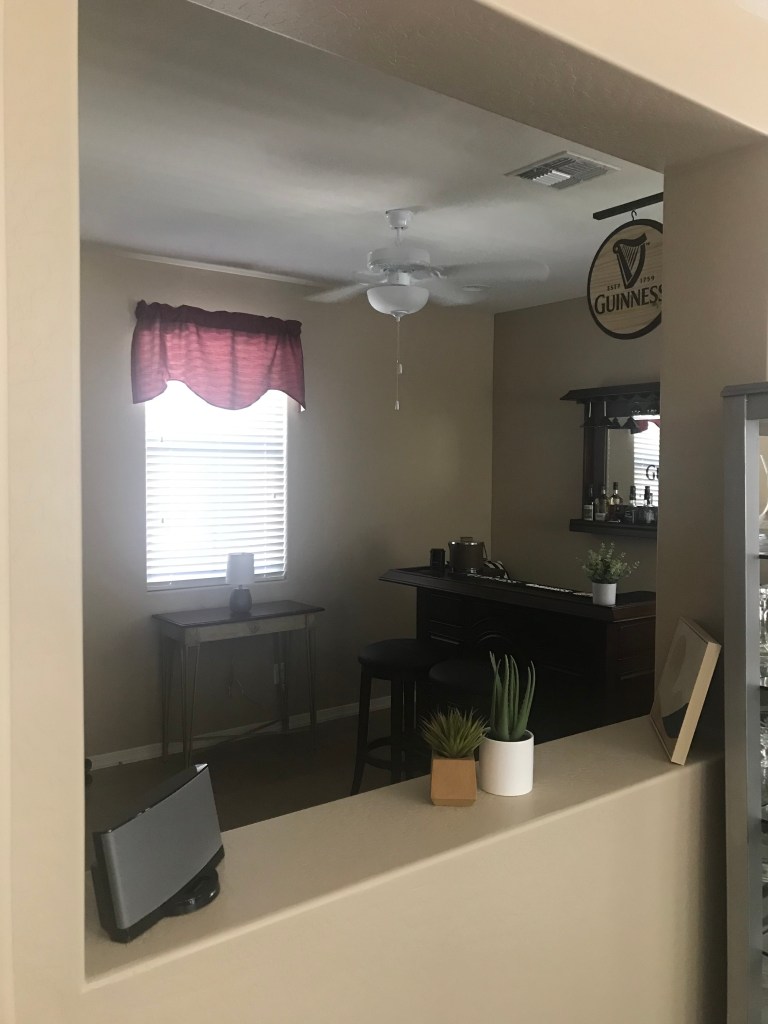
So that meant shopping online for rods and curtains. Because neither John nor I had hung curtains before, we decided to start small: the window in the bar room.

John wanted a green valance to go with the Irish vibe in the room. So I searched. And searched. And searched some more. But the only green valances I could find were for kitchens or Dutch doors. Not exactly the look we wanted in a home bar.

Also, the bar room is adjacent to the living room. So whatever style we chose for the bar room would have to complement the living room.

Then finally, I happened upon a maroon valance at Target with a swag reminiscent of a herald’s banner, which ties into the pub vibe. The valance scrunches a bit too much for my liking, but it only came in one size.

The color wasn’t our first choice but the maroon works with the dark wood tones in the bar and mirror. And it complements the grey, black and white colors in the living room.

For the rod, I picked a simple matte black French pipe that matches the foot rest at the base of the bar. Of course you can’t see the curtain rod, but I know it’s there.

The rod and valance were delivered the following week. The rod came with an anchor, but the weight of it was light enough that we would only need the screws.

The next weekend, John set up the ladder and drill and got to hanging the rod. For those who are new here, John suffered three strokes almost three years ago that left his right hand almost useless.

So that meant drilling the screws into the wall and holding the rod with only his left hand, all while standing on a ladder. Did I mention he was right-handed before the stroke?

Because I tend to overly supervise in these situations, I was more useful to John siting around the corner while he did the installation himself. And can I tell you what a wonderful job he did?

The rod extends evenly across the window. The valance is straight. And the treatment provides the warm homey feeling we were hoping for.

With the window in the bar room done, it’ll soon be time for bigger DIY projects: curtain panels and rods for the large window in the living room and – gasp! – the sliders in the kitchen.

I’ve already started shopping online. But don’t tell John just yet. I don’t want to scare off my personal handyman.

Home repairs in the age of Covid

So you’ve been staying home as much as possible, taking all of the necessary precautions to keep yourself and your family safe from the coronavirus.

You only leave the house when it’s absolutely necessary. You wear a mask in public. You have most everything delivered. You’ve done good.

But a few months have passed, and while locking yourself in your house is working, life isn’t stopping. Situations where you’ll need to interact with other people are cropping up.

What do you do?

Home inspection

John and I had to face this situation recently. We were coming up on a year of being in the new house and wanted to provide the builder with a list of potential fixes.

There were minor things we were aware of, such as a door not closing properly. But to uncover problems we could not see or were not qualified to detect, we had to hire a home inspector.

This meant someone would be in our home – in our personal space – for a couple of hours touching doorknobs, window treatments, and more.

There wasn’t much discussion about it. John and I knew it had to be done. If we thought we would live in this house forever, we may have chosen to accept whatever issues existed and forgo the home inspection.

But because we plan to sell the house in a few years, we knew it would be better to have the builder make the fixes now rather than hope the coronavirus would let up and pay for the fixes ourselves for a prospective buyer later.

Even if it meant allowing a stranger to come into the house at the height of the pandemic.

Establish safety guidelines

Shortly after I started working from home, I had a conversation with a co-worker who was still grocery-shopping in person. I asked her if she was scared. She said yes, but that she wears a mask, shops in the early hours when the store isn’t as crowded, and prays.

John made some phone calls to home inspectors and found one he liked. The home inspector agreed to wear a mask and gloves while in the house and practice social distancing. We set up the appointment.

Because I still work from home, I took the day off. I wanted to be available for any questions or concerns the home inspector might have. But I also wanted him to feel free to inspect the house thoroughly, and not short shrift my work area in order to keep his distance from me.

The process was painless. The inspector wore protection as agreed upon and kept a safe distance during conversations. He wrote up his report at home and e-mailed it to us later to limit the time he spent in our house.

Build up courage, again

The home inspection was behind us, but it was only the first step in the process. Now we had to submit the report to the builder, and meet with the contractor to go over the details.

This meant establishing safety guidelines again and opening our house to another stranger. I took another day off.

Similar to the home inspector, the contractor wore protection and kept a safe distance as he walked through the house, reviewing what the inspector had documented.

He even scheduled some of the exterior work to be done that day to get the ball rolling. For the interior items, the contractor established a schedule that would cause the least amount of disruption to our lives.

But he left it up to us.

Did we want as many tradesmen in the house at one time in order to get the work done quicker?

Or did we prefer limiting the number of tradesmen in the house at a time but schedule the repairs over the course of several days?

We chose the latter, even though it meant building up the courage again and again to open our house to strangers.

The contractor also promised to let the companies know to send their people out with masks and gloves. But as a commitment to our health and well-being, he would leave protection behind for anyone who showed up unprepared.

John had a stroke a few years back and falls into the high-risk category. Because we share a home, I too must take every precaution necessary so as not to pass anything on to him.

Open house

The first few days of repairs went off without a hitch. The tradesmen were punctual, professional and showed up with their own protection.

We had men fixing seals around doors, blowing insulation into the attic, patching and painting stucco, and filling in grout lines.

People were coming and going with John serving as the foreman. It was like that scene in the 1980’s comedy-drama Mr. Mom, but without the steamy shower.

One worker showed up without a mask, but was happy to oblige when John handed him one.

Ongoing work

And no I did not take additional time off. The room in which I work only needed one fix, which took about five minutes. It was quick and easy. Plus, I didn’t want to chance taking the day off and not have a tradesman show up.

In fact, one of the companies did have to cancel, which leaves a few repairs undone. But with the Covid-19 cases at an all-time-high right now, we took it as a sign to hold off.

And so we wait. And pray. Knowing we will have to work up the courage yet again to open our house to strangers to finish the work.

Even in the pandemic, it may be necessary to allow a stranger to come into your home to make repairs. The best you can do is require they wear masks and gloves, and then pray. Photo by Cindy Hernandez.

How I picked an area rug

I did it.

I bought an area rug for the living room.

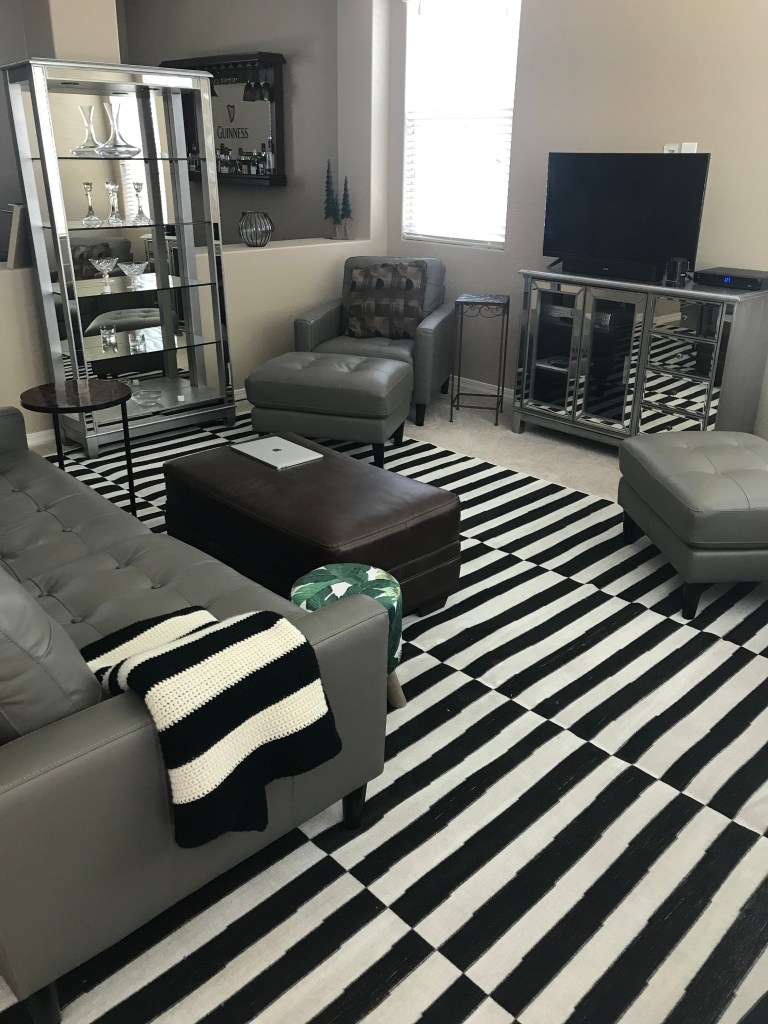
I went with a black and white striped rug to match the monochromatic theme running through the room.

If you recall, I was torn about which style and color to go with. (See “How do you pick an area rug?” May 28.)

I wanted a rug with a pattern and some color, but not so busy that it would draw the eye downward. I had always liked the black and white stripes, but had reservations about going with that pattern, thinking it would be too bland with all of the other black, white and grey in the space. But I decided to go with it after all.

The more I shopped for rugs online, the more overwhelmed I got. And the more rugs I saw, the more I started to change the vision I had for the room. When I noticed myself doing this, I would go back to the black and white striped rug I liked from the start.

Then I would close the laptop and think it over.

Do I want to go contemporary? Or do I want to stay with the Hollywood Regency style that’s underway?

Should I chase a new look or stick with the glitz and glam I started with?

What is my design plan for the space in the years to come? And what about the adjoining rooms? What do I envision for the dining room, kitchen, bar room and entryway?

Every time I answered these questions, I came back to the black and white striped SoHo rug from Rugs.com.

The other factor was that the rug came in 10-feet x 13-feet, the size I needed in order to extend far enough on both sides of the sofa to cover the traffic areas.

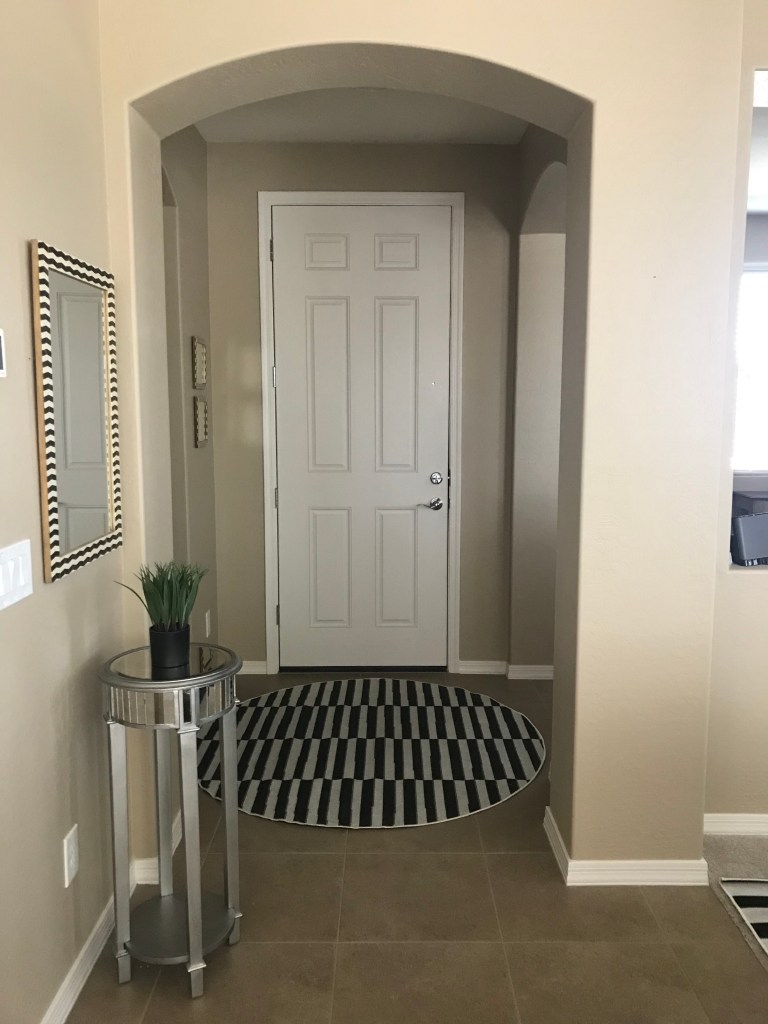
The rug also came in round options, which I absolutely loved. So for the entryway, I bought a matching round 5-foot x 5-foot rug to tie the two spaces together.

You rarely see round rugs. And even though the entryway is square-shaped, the round rug is unexpected and cuts the straight lines within the pattern.

The final deciding factor was some online advice that I received about choosing a rug. I was told to look at photos of rooms I want to re-create in my own home and then choose a rug that was used in those spaces.

Of course. That makes perfect sense.

And each time I researched Hollywood Regency spaces, I saw a lot of black and white in patterns that make a statement. And that’s exactly what I have in my new rugs.

The stripes did jump around after we rolled out the living room rug, almost playing tricks on our eyes. But after we moved the furniture back into place, the stripes became neutralized.

And because the living room is its own defined space, the rug does not impact the adjoining bar room, dining room and kitchen, allowing me to go in a different direction in those areas if I want to.

In the end, the black and white striped rug was the best choice.

So what is a design trifecta?

I’ll attempt to answer this question by asking another question:

When it comes to decorating your home, what do you want your furnishings to accomplish?

Let me break it down a little further.

If you need a new couch for your loft, what do you want that couch to do? Do you want it to provide seating? That would be function.

Do you want the couch to look pretty? That would be style.

Do you want a couch that you can relax on all weekend, melt into, maybe even take a nap on? That would be comfort.

Often times, furniture does one or two of these things. But when it does all three, well, that’s the design trifecta.

I’m a firm believer that furniture and home decor can encompass all three elements. It just takes a little more work – as in a little more shopping – to find the perfect pieces. It’s not always easy.

Have you ever been to a friend’s house for dinner and sat on the most uncomfortable dining chair? It may have looked fabulous in the space, but your backside paid for it the next day.

The chair had style and function but lacked comfort. Any maybe after the soup, it started to lack function too.

Or maybe you dated a guy in college that had the most comfortable recliner, but it was hideous to look at. Because it lacked style.

Small spaces beg for the design trifecta. They have to. There’s not a lot of room to waste. The design plan has to be smart all the way through – from the couch to the bed to the dining suite to the kitchen accessories.

Larger homes have more space to work with, but they also have more room for error.

The couch is too puny for the room. The dining table is the wrong shape for the space. The bar stools are too tall for the countertop. The cushions on the patio furniture are too thin. The living room doesn’t have a side table in reach to set down a beverage.

The list is seemingly endless.

And I’m not writing about this because I have design trifecta running through my house. No, but I am writing from the experience of failure.

I had limited space in my condo and had to be smart about the pieces I brought into it. And I chose wrong over and over again. In fact, in the 18 years of living there, I never conquered the space limitations.

I had a living room that had only one uninterrupted wall. The front door and a fireplace took up another side. A sliding glass door took up another side. The fourth side was open to the kitchen.

It was frustrating trying to create a functional living space that didn’t look cluttered. It was nearly impossible. No, not nearly impossible. IT WAS IMPOSSIBLE.

That’s when I realized I had to be smart about the furniture I chose. Each piece had an assignment: they had to provide function, style, and comfort. All at the same time.

Think of the Murphy bed.

You often see the Murphy bed in a room that has to do double duty, typically a guest bedroom and an office.

When guests are over, the bed comes down from the wall. When the guests are gone, the bed is lifted back up and the room is an office again. Cubbies and shelving on the underside of the bed add style and more function for the office. It’s genius.

It has to be genius because most of us cannot accomplish the trifecta on our own for every piece of furniture we bring into our homes. We either don’t think about it, or it’s too time-consuming, or we focus on comfort or style and forget about the other two elements.

John and I will soon be shopping for a couch for the loft, which is where I got my example above. A part of me is excited to bring a new piece of furniture into the house. The other part of me is nervous about picking the wrong piece for the reasons I’ve outlined in this blog.

We have a couch in mind that we saw at American Furniture Warehouse a year ago. The couch hits the design trifecta – function, style and comfort. But I wouldn’t be me if I still didn’t worry that it’ll fall short in some area once we bring it home.

The couch is also priced right, which actually makes it a design quadfecta. Oh, did I not mention the forth element of home decor?

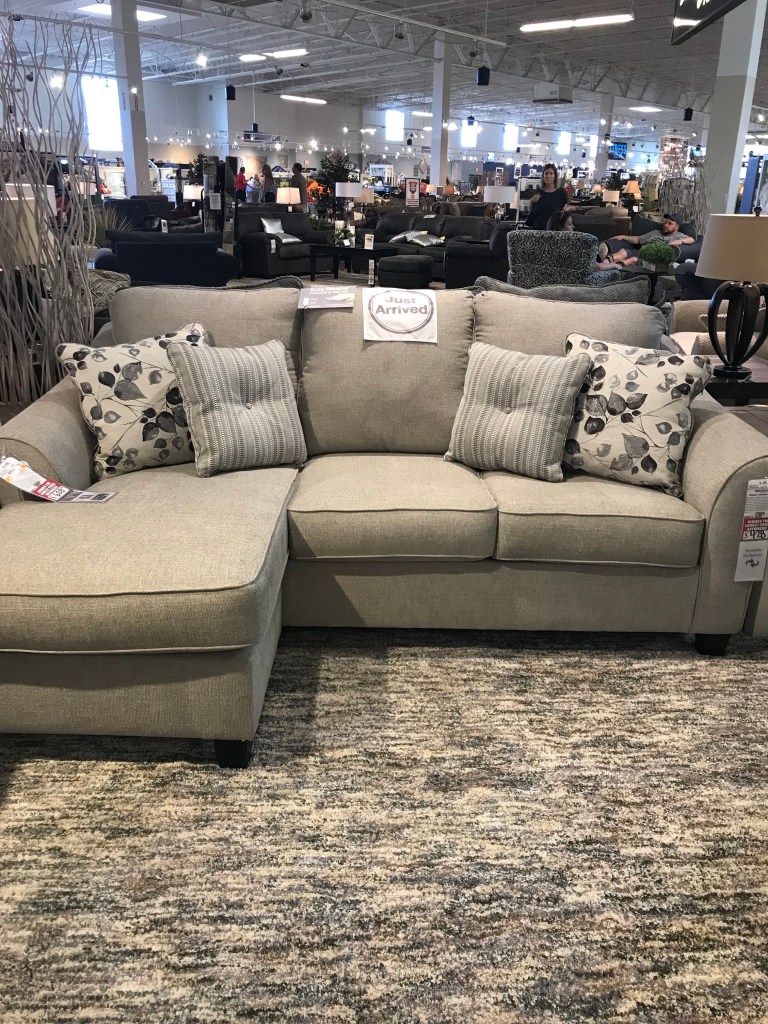
This couch is in the running for the loft and hits the design trifecta of style, comfort and function. Photo by Cindy Hernandez

Why the C-table is a design trifecta

Whoever invented the C-table must have had me in mind.

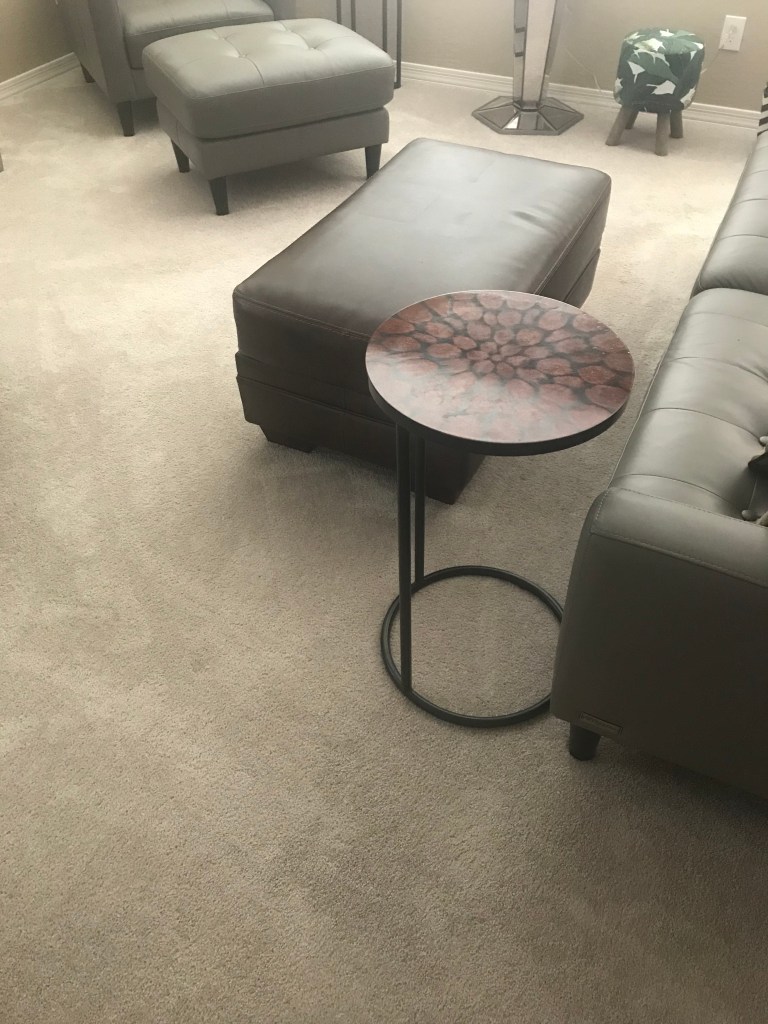
I have two C-tables. One of them, a red and black one, I keep near my favorite spot on the couch.

It holds my cup of coffee in the morning, my glass of wine at night and my bottle of water in between. I can’t live without it.

If you’re thinking, “She’s going to write another love letter to a table, isn’t she?” The answer is yes. This is a design blog, after all, and I hear personal stories are popular. (See published posts for “The story of an accent table,” April 13, 2020.)

Now back to the C-table.

I bought my first one at Pier 1 Imports several years ago. I was living at my condo at the time and space was at a premium.

I loved that I could move the table around to where I needed it.

The tabletop, legs and base are shaped like the letter C, allowing the base to slide under a couch or chair and the tabletop to practically rest on my lap.

I’ve used the table to polish my fingernails. I’ve used it as a TV tray. I set my phone on it. Notebooks. Laptop. You get the idea.

Even in the new house, the C-table is perfect.

I don’t have space on either side of the couch for end tables unless I block the flow of traffic in and out of the room. The C-table solves that problem.

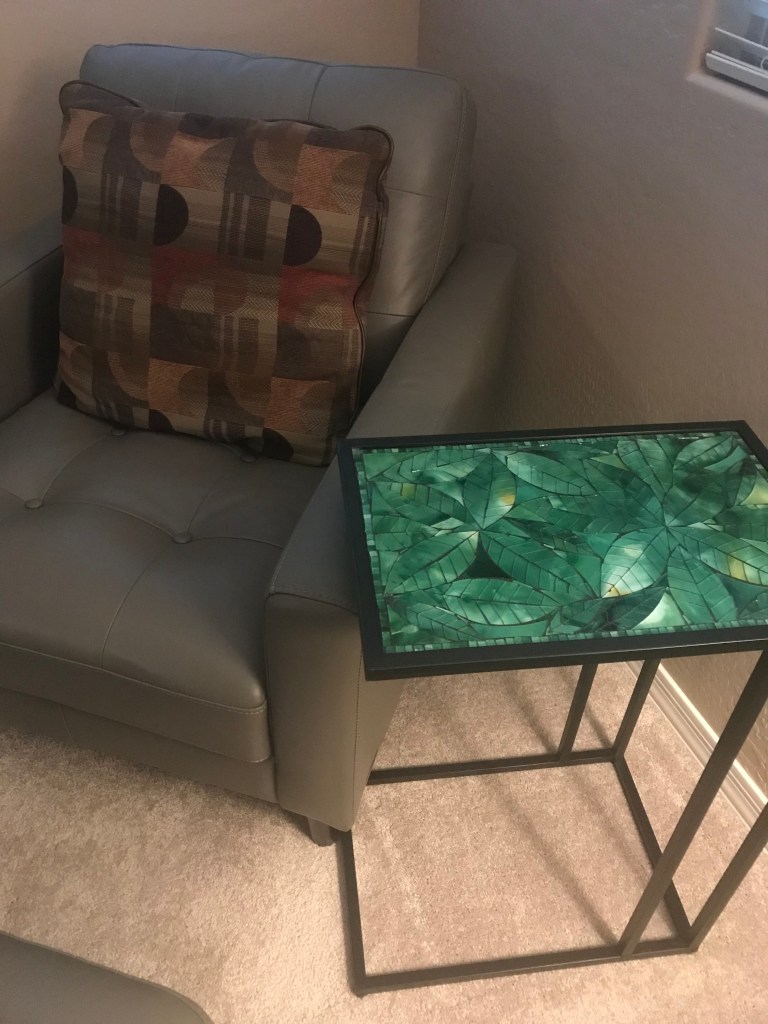
I bought the second C-table during the construction of the new house. It is situated next to a chair in the living room. It hardly gets used but it’s there because I’m sure the time will come when I’ll need it.

To be honest, I bought the second C-table more for the green-leaf design that I’m brining into the living room. But that I found the perfect pattern in a C-table was a match made into decor heaven.

I’m being silly now. But these small wins in the design world are astronomical when it comes to furnishing a home. Function is key. Yes from the outside, it’s all pretty stuff. And sometimes that’s all it is.

But if you can design a space that is functional, stylish and comfortable, well that’s the design trifecta.

The C-table is a great alternative when space is limited. Photos by Cindy Hernandez

Social-distancing Goldilocks

NOTE: Arizona Gov. Doug Ducey held a press conference Thursday afternoon to say the state has enough hospital beds to accommodate the rising number of reported Covid-19 cases. His comments were in response to one of the state’s health systems saying last week that they would hit capacity if the numbers continued to rise. Ducey added that he supports the public wearing face masks when it is not possible to social distance. Even though he has been seen in public doing neither when both were possible.

The number of confirmed cases of Covid-19 in Arizona is climbing, and there’s no indication the governor will issue another stay-at-home order to help slow the spread.

Not that I’m surprised.

This is a conservative governor.

A businessman.

If the coronavirus is hurting their bottom line, Gov. Doug Ducey is not about to make it worse for businesses by closing the economy again.

But that doesn’t mean the citizens of Arizona, or any other state that has an open economy, cannot issue their own stay-at-home orders.

And by that I mean, citizens can choose to limit the time they spend in public.

I’ve been social distancing since March 13, the day after my employer sent me home with my laptop.

I only leave the house for essential reasons. When I do leave, I wear a mask and take the safety precautions set forth by the Center for Disease Control.

I spent Mother’s Day visiting with my parents on their front porch for 15 minutes while wearing a mask. Last week, I helped my parents clean their house all while wearing a mask and keeping a safe distance.

Do I like it? Of course not. But if it saves my life and the lives of my loved ones, I’ll do it. And I’ll keep doing it.

Just because the economy is open doesn’t mean I should shop for groceries in person, meet friends for lunch, book a trip to Vegas, and have the family over for a cookout.

No, I have a brain.

I can read the numbers.

I can think for myself and take responsibility for myself.

If I want to limit my time in public, I’ll limit my time in public. My life cannot wait for the governor to put restrictions in place to help slow the spread.

Heck, Ducey doesn’t even wear a mask in public. You would’t know there was a pandemic if you saw him.

New York Gov. Andrew Cuomo has been a true leader in this regard, closing the Empire State until its numbers peaked.

Ducey, on the other hand, followed President Trump’s lead early on and issued stay-at-home orders for non-essential businesses.

But businesses suffered. People lost their jobs. Citizens showed up at the state Capitol to protest the order and demand Ducey reopen the economy, which he has done in phases, with the numbers to prove it.

As of this writing, Arizona has over 29,000 confirmed cases with 1,000-plus reported deaths, according to the state’s Department of Health Services. The health director followed it up by telling hospitals to activate their emergency plans.

Ducey should have extended the stay-at-home order until Arizona reported a steady decline in numbers. At least it would have been worth closing the economy.

But to close the state for a month or so, I am not sure what was accomplished. And now that he’s let the order expire, there’s no going back.

People don’t want to be told they cannot leave their homes. Even if it’s for the greater good. Businesses don’t want to be told to close their doors. Heck, not everyone’s convinced there’s even a problem.

The media have calls into the governor’s office asking about a stay-at-home order. And I get why. With people running around town without protection, we’re all at risk.

That’s why I continue to stay at home as much as possible, wear a mask in public, and practice social-distancing.

The governor, on the other hand, has been silent. Even if he chooses to keep the economy open, he still should address the good people of this state and make his case. At least then I could respect him for owning his decision.

Masks are just one of the precautions I take to keep myself safe from Covid-19. Photo by Cindy Hernandez